
War, Stress and Hair Loss in Israel: How the Tension of 2026 Affects Hair Health and What You Can Do
In 2026, many people in Israel are living under constant pressure: news alerts, security concerns, uncertainty, lack of sleep, fear for family members, and the emotional fatigue that comes from staying alert for too long. In such a reality, hair loss may seem like a secondary problem. But for someone who finds more hair on the pillow, in the shower, on the brush or on clothes, it becomes very personal very quickly.
In Haifa, Abramsky – Hair Health Center in Haifa works with hair loss, thinning hair, damaged hair and scalp problems through a diagnostic and treatment-oriented approach. The center’s English page presents it as a place focused on hair loss, baldness, thinning hair, damaged hair and scalp concerns in Haifa.
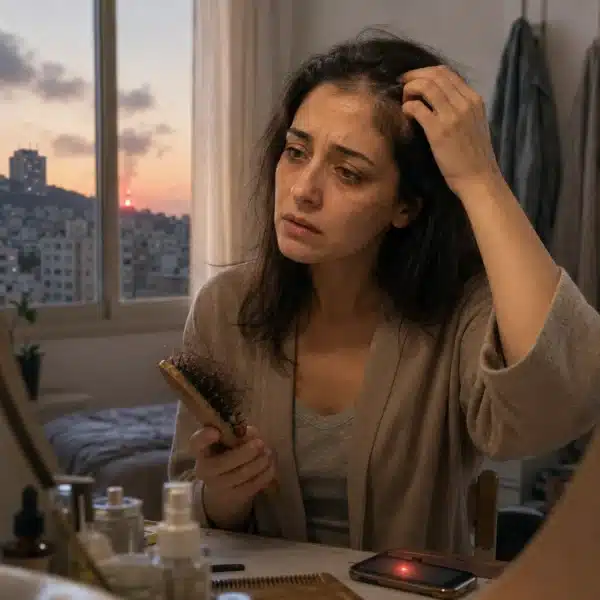
Why wartime stress can affect hair
Hair does not usually fall out because of one difficult day. The problem often develops after weeks or months of tension, poor sleep and emotional overload. The body starts to prioritize survival systems: the heart, nervous system, muscles, breathing, immune response and stress regulation.
Hair follicles are sensitive to internal changes. When the body is under prolonged pressure, the growth cycle of hair may be disrupted. Hair may enter a resting phase earlier than expected, become weaker, thinner or more fragile. Sometimes the person begins to notice the change only two or three months after the most stressful period.
That delay is one reason people often feel confused. They may say: “The worst has already passed, so why is my hair falling out now?” But the body does not always react immediately. Hair often reflects what the body has been through earlier.
The emotional loop: stress causes hair loss, hair loss causes stress
One of the most painful parts of stress-related hair loss is the emotional loop it creates. A person starts checking the brush every morning. Then the shower drain. Then the parting line. Then old photos. Every new sign of thinning becomes another reason to panic.
This panic can make the problem feel worse. The person sleeps less, eats irregularly, drinks too much coffee, searches online for quick solutions and buys products that may not match the real cause of the problem.
Hair loss during a difficult period in Israel can be connected to stress, but stress is not always the only factor. There may also be iron deficiency, vitamin D deficiency, hormonal changes, genetic tendency, scalp inflammation, recent illness, medication changes, aggressive coloring, heat styling, sun exposure, hard water or poor nutrition.
“When a person says, ‘It is probably just stress,’ that should not be the end of the conversation. Stress may be the trigger, but the scalp, follicles and hair quality still need to be checked properly.”
The real pain: what patients usually notice first
The first pain is fear. People are afraid that the hair will not return, that the parting will become wider, that others will notice, or that the problem is the beginning of permanent thinning.
For many women, hair is tied to confidence, femininity, age, work, relationships and social presence. For men, sudden thinning or a receding hairline can also create a strong sense of losing control, especially when life already feels unstable.
The second pain is confusion. One person recommends a shampoo. Another suggests oils. A third says not to wash hair too often. Someone else says daily washing is necessary. Social networks add even more noise. In the end, the person may spend money, time and emotional energy without understanding what is actually happening.
The third pain is shame. Some people hide the problem, avoid photos, change hairstyles, stop going out as much or feel uncomfortable under bright light. This is why hair loss should not be dismissed as “only cosmetic.” It can deeply affect quality of life.
When thin and brittle hair becomes part of the problem
Hair loss is not always only about hair falling from the root. Sometimes the hair is still there, but it becomes thin, brittle, dry and weak. It breaks along the length, loses shine, tangles more easily and no longer holds volume.
In Israel, this may be worsened by sun, heat, humidity, sea water, pool water, coloring, straightening, styling tools and stress. In Haifa and the northern region, many people also deal with a demanding lifestyle, long commutes, family pressure and ongoing security tension.
This is why the issue must be treated as a whole picture. The scalp is the environment where the follicles live. If the scalp is irritated, inflamed, too oily, too dry or uncomfortable, hair quality may suffer as well.
What to do first: do not treat blindly
The first step is not panic. Hair loss after stress does not mean that everything is lost. In many cases, the situation can improve when the cause is understood and addressed early enough.
The second step is diagnosis. Without understanding the cause, people often treat the wrong problem. A shampoo cannot correct a deficiency. A mask cannot solve follicle weakness. A cosmetic oil cannot treat scalp inflammation. A supplement will not help much if the main issue is genetic thinning or chronic scalp imbalance.
The English hair-loss page of Abramsky Hair Health Center’s trichology service in Haifa focuses specifically on hair loss, baldness, thinning hair, damaged hair and scalp problems, which makes it relevant for people who need more than a general beauty routine.
The third step is to reduce additional damage. During active shedding or thinning, it is better to be careful with harsh coloring, frequent heat styling, tight hairstyles, aggressive brushing and random product experiments.
Building the foundation for recovery
Hair recovery requires a foundation. This includes sleep, nutrition, enough protein, hydration, checking possible deficiencies when needed, reducing inflammation, protecting the scalp and choosing treatments according to the real condition.
A professional may recommend scalp care, follicle-supporting procedures, PRP, mesotherapy, programs for damaged hair, scalp balancing or other supportive protocols. But the right plan depends on the diagnosis. There is no single universal solution for everyone.
For people in Haifa, Kiryat, Nesher, Tirat Carmel, Acre and the wider northern region, location also matters. Regular follow-up is easier when the center is accessible. The Yandex Maps listing for Abramsky in Haifa shows the address at 44 Histadrut Boulevard, Haifa, and the contact phone number +972 55 939 7729.
Why scalp health matters during stressful periods
Stress can affect not only the hair shaft, but also the scalp. Some people notice itching, burning, dandruff, redness, oiliness, sensitivity or discomfort. Others feel that their scalp became “tight” or painful.
These symptoms should not be ignored. The scalp is not just skin under the hair. It is the biological environment of hair growth. If this environment is not balanced, even good hair care products may give only temporary cosmetic improvement.
This is especially important during wartime stress. People may sleep less, sweat more, change routines, wash hair irregularly, eat differently or forget regular care. The scalp may react to all of this.
For updates, professional presence and additional information, the center can also be followed through Hair Health Haifa on LinkedIn, which is useful for people who want to connect with the professional side of the project.
When you should not wait
It is worth seeking a consultation if hair loss continues for more than several weeks, if the parting becomes wider, if the ponytail becomes noticeably thinner, if the scalp itches or hurts, if dandruff appears, if the hair breaks more than usual, or if home care stops helping.
It is also important to pay attention if the hair loss started after a period of war-related stress, grief, fear, lack of sleep, illness, relocation, work overload or family pressure. The hair may react later, so the connection is not always obvious at first.
The goal is not to create fear. The goal is to act early and intelligently. The earlier the cause is understood, the better the chances of slowing the process, supporting the follicles and improving the condition of the scalp and hair.
Contact information
Abramsky – Hair Health Center in Haifa
Address:
44 Histadrut Blvd., Check Post, Haifa, Israel
Phone:
055-939-7729
Opening hours:
Sunday-Thursday: 10:00-19:00
Friday and holiday eves: 09:00-14:00
Saturday: Closed
Online contact through the website is available 24/7.
War, chronic stress and emotional exhaustion can affect the body, and the hair often shows those signals visibly. But hair loss, thinning and brittleness are not a sentence. With proper diagnosis, realistic expectations and a professional plan, it is possible to stop guessing and start dealing with the problem in a structured way.