
Hair can react to stress, heat, humidity, poor sleep, internal changes and scalp problems. For residents of Haifa, Krayot, Nesher, Tirat Carmel and Northern Israel, professional hair and scalp diagnosis is becoming increasingly relevant.
When Hair Becomes a Warning Sign
In Israel, more and more people are facing a problem they first try to explain away as fatigue, seasonality or ordinary stress. Hair begins to fall out more noticeably, becomes thinner, loses volume faster, breaks more easily, and the scalp reacts with itching, dryness, oiliness, flaking or irritation.
For some, it starts with hair on the pillow. Others notice it in the shower, on the brush, or after styling. For many women, the parting line becomes wider. For many men, the hairline starts to look weaker. What used to feel like a private beauty concern gradually becomes something more serious: a sign that the body may be under pressure.
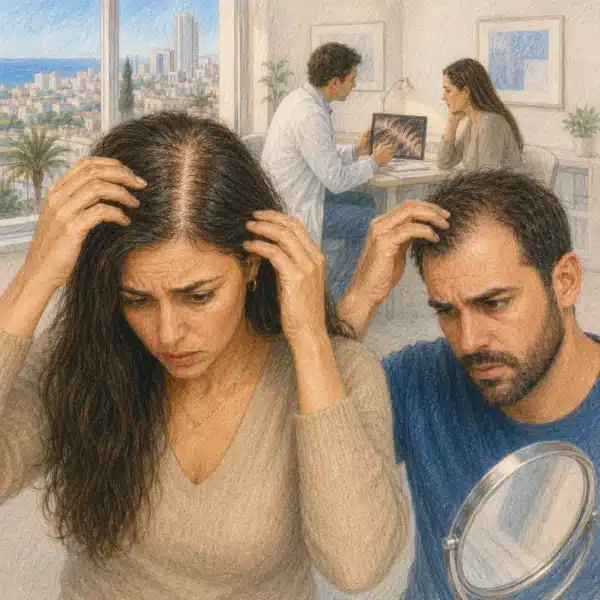
At first glance, this may seem like a purely cosmetic issue. In reality, hair often becomes one of the first visible signals that a person has been living under long-term overload. The Israeli pace of life, constant anxiety, family pressure, work, heat, humidity, strong sun, poor sleep and emotional tension can all affect the condition of the hair and scalp.
The problem does not always appear immediately. A person may go through a difficult period, return to normal life, and only weeks or months later realize that the hair has changed. It feels weaker. It breaks more easily. It gets oily faster. The scalp becomes more sensitive.
That is why the main question today is not “what should I apply to my hair right now?” The more important question is: why did the hair start weakening at this particular moment, and what does the scalp show?
The Main Concerns: What Women and Men Notice First
For women, one of the most painful concerns is the loss of density. Hair may not fall out in dramatic clumps, but it gradually becomes thinner. The parting looks wider, volume disappears a few hours after styling, the ponytail feels less full, and the hair looks tired.
This is especially common after childbirth, during hormonal changes, after prolonged stress, dieting, sudden weight loss, lack of sleep or emotional strain. A woman may think for a long time that it is simply age, fatigue or the result of coloring. But when the change continues, the problem deserves a closer look.
There is also another emotional layer: the fear that the scalp is becoming visible. To others, the change may barely be noticeable. But the person sees it clearly. The parting is different. The hair near the face is weaker. Styling no longer helps. Photos become uncomfortable. This affects confidence, mood, communication, work and the desire to appear in public.
For men, the concern often starts with the front hairline, receding areas, thinning zones or the feeling that the hair has become weaker. Not everyone wants to immediately discuss radical solutions. Many first want to understand what is happening: is it a temporary reaction, age-related thinning, a stress response, or a process that needs proper monitoring?
Another major issue is the scalp itself. In Israel, people often complain about itching, dandruff, oiliness, dryness, irritation, redness, flaking and discomfort near the roots. Sometimes the scalp feels as if it is burning. Sometimes it becomes painful to touch. Sometimes it becomes oily again the day after washing.
This is where the key point begins: hair should not be examined separately from the scalp. If the scalp is irritated, overloaded by sweat, sun, coloring, stress or unsuitable care routines, this may affect both the appearance of the hair and the feeling of density.
Israeli Stress and Hair
For Israel, the topic of stress is especially sensitive. People live under constant information pressure, often sleep badly, worry about children, relatives, safety, work, home and the future. This type of pressure is not always visible from the outside, but the body can react to it.
Hair may become one of those signals. A person may keep functioning, working, caring for family and doing everything expected of them. Then, after some time, they notice that the hair has lost its former strength.
This can be frightening, especially when there seems to be no obvious reason. But this is exactly when it is important not to panic. The right step is to understand what is happening with the scalp, roots, density, hair structure and the person’s overall condition.
Thinning, Breakage and Loss of Hair Quality
Many people do not immediately describe their problem as “hair loss.” They say it differently: the hair feels empty, thin, fragile, dry, dull, harder to style, more tangled, or more prone to breaking. Sometimes the person does not see whole hairs falling out from the root, but rather short broken pieces after brushing.
This is a separate and important concern. Thinning and breakage may look minor at first, until the change becomes visible. The hair is still there, but it no longer looks the same. There is less volume, less density, less elasticity and less life.
In Israeli conditions, this becomes even more relevant. Sun, heat, dry air in summer, humidity, seawater, swimming pools, coloring and constant movement between outdoor heat and air-conditioned rooms can gradually affect the quality of the hair. If stress, fatigue and internal imbalances are added to this, the hair may begin to weaken faster.
Another important part of the picture is scalp hygiene and inflammation. One of the service pages of the Haifa Hair Health Center focuses on antibacterial care for the scalp, describing problems such as dandruff, itching, sensitivity, excessive oiliness, bacterial irritation and scalp inflammation as possible factors connected to discomfort and hair problems. The page also emphasizes diagnosis of the scalp before choosing a suitable approach.
That is why the issue should not be reduced to the length or shine of the hair. Sometimes the real question is what environment the hair is growing from.
Why Waiting for Months Can Be a Mistake
One of the most common mistakes is waiting for everything to pass by itself. Sometimes the condition does improve if the cause was temporary. But if the hair continues to thin, the scalp remains uncomfortable, volume does not return, or the parting becomes wider, it is better not to postpone diagnosis.
The longer a person acts randomly, the harder it becomes to understand the real picture. During this time, they may change dozens of products, listen to friends, follow social media advice, read contradictory recommendations and become even more confused.
The problem is not that people do nothing. Very often, they do too much — but without knowing the reason. Hair does not respond to panic. It responds better to a precise and consistent approach.
Why Diagnosis Matters More Than Random Solutions
The main purpose of diagnosis is to understand where the problem begins. It may be connected to the scalp, the roots, hair structure, nutritional deficiencies, stress, hormonal changes, age-related factors, coloring damage, an unsuitable care routine or a combination of several factors.
That is why a professional approach begins not with promises, but with evaluation. It is important to understand how serious the thinning is, whether there is irritation, what the scalp looks like, how weakened the hair is, when the changes began and what background factors may have contributed.
The connection between scalp discomfort, brittle hair and hair shedding is especially important. A Russian-language page of the center explains this logic directly: itching, scalp problems, brittle hair and “quiet” alopecia may be connected, and hair changes should be understood together with the condition of the scalp rather than treated as separate issues.
For readers of NAnews – Nikk.Agency Israel News, this topic is important because it is part of everyday life in Israel. Hair is not only about appearance. It can show fatigue, long-term tension, poor recovery, internal changes or scalp problems that a person has ignored for too long.
When It Is Time to Book a Consultation
A consultation may be useful not only when hair is falling out heavily. Diagnosis is also relevant when hair becomes thinner, loses volume, gets oily faster, grows more slowly, breaks, tangles or looks weaker than before.
It is also worth paying attention if the scalp itches, flakes, becomes red, oily, painful, sensitive or irritated.
Special attention is needed after strong stress, childbirth, dieting, sudden weight loss, hormonal changes, prolonged lack of sleep or any period when the body was clearly overloaded.
Local Help in Haifa, Krayot and Northern Israel
For residents of Haifa, Check Post, Krayot, Nesher, Tirat Carmel and Northern Israel, general information from the internet is not enough. People need a clear local place where they can begin with an assessment of their hair and scalp condition.
This is where אברמסקי שיער – המרכז לבריאות השיער בחיפה — “Abramski” Hair Health Center in Haifa — fits into the local picture. The center focuses on hair and scalp diagnosis, consultations for hair shedding, thinning, breakage, loss of density, itching, dandruff, oiliness, dryness and scalp irritation.
The geography includes Haifa, Check Post, Krayot, Kiryat Ata, Kiryat Bialik, Kiryat Motzkin, Kiryat Yam, Nesher, Tirat Carmel and Northern Israel. For residents of these areas, Haifa is often a convenient point for consultation without a long trip to the center of the country.
The Yandex Maps listing for “Abramski” confirms the local presence of the center in Haifa at 44 HaHistadrut Avenue, with the phone number +972 55 939 7729, and lists services related to diagnosis of hair loss causes, computerized scalp and follicle analysis, diffuse hair loss and alopecia support.
The main value of this approach is calm understanding. Not to frighten the person, not to give the same answer to everyone, but to examine the specific situation: what is visible now, what symptoms repeat, what factors may have influenced the condition, and what the next logical step should be.
Contacts
אברמסקי שיער – המרכז לבריאות השיער
שד’ ההסתדרות 44, צ’ק פוסט, חיפה
טלפון / וואטסאפ: 055-939-7729
אימייל: info@hair-health-center.nikk.co.il
FAQ
Can stress cause hair loss?
Yes. Long-term stress, anxiety, lack of sleep and emotional overload can affect hair condition. Hair shedding often becomes visible not immediately, but some time after a difficult period.
Why has my hair become thinner if I am not visibly balding?
This may be thinning, loss of density or weakening of the hair structure. People usually notice it through the parting, volume, ponytail thickness, breakage and overall density.
Can itching and dandruff be connected to hair shedding?
Yes. The condition of the scalp should be evaluated together with the hair. Itching, dryness, oiliness, irritation and flaking may accompany weakening hair.
When should I go for hair and scalp diagnosis?
If shedding continues, hair visibly loses density, the scalp causes discomfort, or the problem appeared after stress, childbirth, dieting, hormonal changes or prolonged lack of sleep.
Who is the Haifa center suitable for?
It is suitable for people living in Haifa, Krayot, Kiryat Ata, Kiryat Bialik, Kiryat Motzkin, Kiryat Yam, Nesher, Tirat Carmel and Northern Israel who want to begin with hair and scalp diagnosis.