
Hair Loss in Israel: What People Face, Why It Starts, and How It Can Be Addressed
Hair loss is one of the most common concerns people raise when they start paying attention to their appearance and overall well-being. In Israel, this issue affects men and women of different ages and backgrounds. Some notice hair left on the pillow or in the shower, others see their part widening or their hair losing volume, and some simply feel that their hairstyle no longer looks or behaves the way it used to. In most cases, these changes develop slowly and are easy to dismiss at first.
Many people try to manage the situation on their own by switching shampoos, using serums or supplements, or following advice found online. Sometimes this leads to short-term improvement, but very often the problem continues to progress. This is usually the point when people realize that without professional assessment and a structured approach it is difficult to move forward, and they begin looking for specialized solutions such as those offered by the Hair Health Center in Haifa, where the focus is on understanding the cause rather than masking the symptom.
Hair loss is not a standalone condition. It is usually a response of the body to internal or external changes. Hair follicles are highly sensitive to stress, hormonal shifts, nutritional imbalances, and environmental factors. In Israel, these triggers are particularly common, which explains why complaints about hair loss are widespread across the population.
Why Hair Loss Is So Widespread in Israel
Climate plays a significant role. Strong sunlight for most of the year, heat, dry air in some seasons and high humidity in others all affect scalp health. The skin becomes more vulnerable, moisture balance is disrupted, and blood circulation around hair follicles may decrease. Over time, this weakens the follicles and pushes hair into the shedding phase earlier than expected.
Another contributing factor is frequent exposure to sea water and swimming pools. Salt and chlorine damage the hair shaft and irritate the scalp. Even when these effects are not immediately visible, repeated exposure can gradually weaken hair structure and slow down growth.
Stress is also a major factor. A fast-paced lifestyle, ongoing tension, and emotional pressure influence hormonal balance and disrupt the natural hair growth cycle. Stress-related diffuse hair loss is one of the most common patterns seen in clinical practice in Israel.
In addition, hair loss may be influenced by hormonal changes, iron or micronutrient deficiencies, thyroid disorders, and genetic predisposition. In most cases, it is not one single cause but a combination of factors, which is why generic solutions rarely deliver lasting results.
How Hair Loss Typically Appears
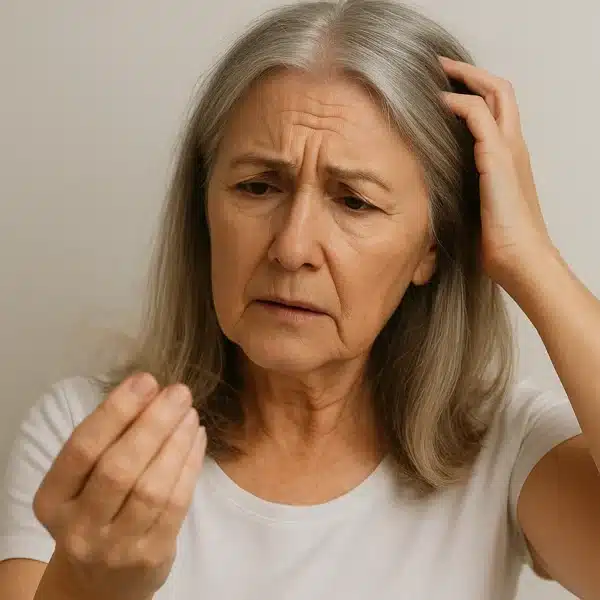
Hair loss does not always mean sudden or dramatic shedding. For many people, the first sign is gradual thinning. Individual hairs become finer, overall density decreases, and growth slows down. Even if the number of shed hairs does not seem excessive, weaker regrowth creates the impression that hair is disappearing.
For others, hair loss is more noticeable. Hair accumulates on brushes, in the shower drain, or on clothing. This may be accompanied by scalp discomfort, itching, or a burning sensation, indicating that the problem involves not only the hair itself but also the condition of the scalp.
Why Self-Treatment Often Fails
One of the most common mistakes is trying to treat hair loss without understanding its cause. Products are chosen based on reviews, trends, or advertising claims. While shampoos and masks may temporarily improve appearance, they do not affect follicle function or address deeper issues.
Supplements are not always effective either. If hair loss is driven by stress, hormonal imbalance, or scalp inflammation rather than nutritional deficiency, supplements alone will not stop the process. Without proper diagnosis, people often lose valuable time while the condition continues to progress.
A more structured explanation of how professional scalp care and long-term maintenance support hair health is available in the clinic’s Hebrew-language section dedicated to scalp treatment and ongoing hair care principles, where the focus is on consistency rather than quick fixes.
What Approaches Actually Help
Effective management of hair loss always begins with diagnosis. It is essential to determine the stage of the hair growth cycle, assess follicle activity, and identify whether inflammation or imbalance is present on the scalp. Only after this step can realistic treatment options be discussed.
Different causes require different strategies. In stress-related or diffuse hair loss, the goal is to stabilize the growth cycle and improve circulation. In hormonally driven hair loss, supporting follicle activity and slowing progression becomes the priority. When scalp health is the main issue, restoring balance is the first step.
Modern treatment options may include advanced device-based therapies, injection techniques, mesotherapy, PRP procedures, and supportive maintenance programs. There is no single solution that fits everyone, which is why personalization is essential.
How Hair Loss Is Addressed at the Hair Health Center in Haifa
The center works according to a simple principle: first understand the situation, then take action. The process starts with computerized diagnostics that provide an objective view of scalp condition, hair density, follicle activity, and growth phases.
Based on these findings, an individual treatment plan is created. This plan may include procedures aimed at stimulating growth, restoring scalp health, supportive therapy, and guidance for home care. Each step is explained clearly, without promises of instant results.
Special attention is given to local conditions in Israel, including climate, sun exposure, stress levels, and daily routines. This allows for more stable, long-term results rather than temporary improvements.
Location and Accessibility
The Hair Health Center is located in Haifa and serves people from across Northern Israel. Regular visitors arrive from Kiryat Yam, Kiryat Bialik, Kiryat Motzkin, Kiryat Ata, Nesher, Tirat Carmel, Acre, Atlit, Zikhron Ya’akov, Yokneam Illit, Migdal HaEmek, Daliyat al-Karmel, Isfiya, Shefa-Amr, Rekhasim, and Ibtin.
For most people, travel time ranges between twenty and forty minutes, making follow-up care and ongoing treatment practical without the need to travel to central Israel.
Why Waiting Is Risky
Hair loss rarely begins suddenly. The process develops over time, and by the moment visible changes appear, some follicles are already weakened. Early diagnosis significantly increases the chances of preserving existing hair and slowing further thinning.
A professional approach does not guarantee immediate results, but it provides something more important: clarity and a realistic plan of action.
Conclusion
Hair loss in Israel is a common, multi-factor issue influenced by climate, stress, hormonal changes, and scalp condition. There is no universal solution, but there is professional diagnosis and individualized care.
The Hair Health Center in Haifa focuses on identifying the underlying causes, offering evidence-based solutions, and supporting people throughout the process. A more detailed background about the clinic’s work and philosophy is also available in a comprehensive Russian-language overview of the Hair Health Center in Haifa, which provides additional context for those who prefer to explore the topic further.