
Why Women in Israel Notice More Hair Loss in Autumn — and What to Do About It
More hair in the shower, a brush that needs cleaning more often, and a ponytail that suddenly feels thinner are common reasons women start worrying in September and October. The easiest explanation is usually “seasonal shedding.” Sometimes that is part of the picture, but autumn does not explain every change.
For women in Israel, the timing comes after months of heat, strong sun, sea water, swimming pools and air conditioning. At the same time, stress, illness, weight loss, childbirth, hormonal changes, low iron stores or thyroid problems may also affect the hair. The useful question is not simply whether hair can shed more in autumn, but what has actually changed.
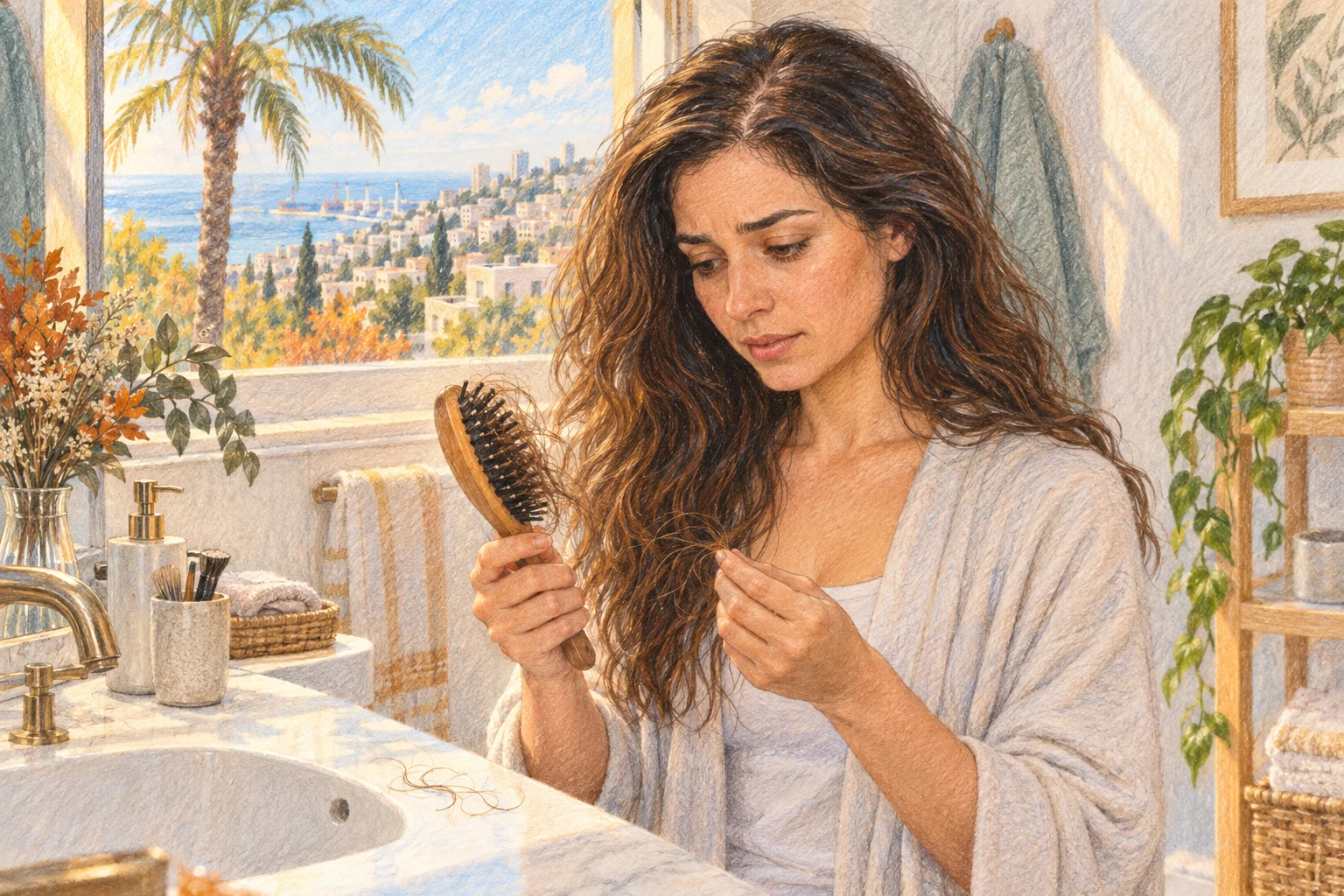
1. Why does shedding become noticeable in autumn?
Hair does not always react immediately to what happens to the body.
A stressful period, illness, high fever, rapid weight loss, surgery, childbirth or another major change may affect the hair cycle first, while the visible increase in shedding appears weeks or months later.
That is why a woman may feel completely better by October and still suddenly notice much more hair in the shower.
Seasonal variation in the hair cycle has also been observed in research, including studies in women. But seasonality alone cannot explain every case of thinning.
2. Is the hair falling out from the root, or breaking after summer?
These are not the same problem.
After an Israeli summer, hair may be drier, rougher and more fragile. Sun exposure, sea water, pools, colouring, frequent washing and hot styling can all affect the hair shaft.
If shorter broken hairs are appearing around the sink, on clothing or through the lengths, part of the problem may be breakage rather than increased shedding from the follicle.
Check the pattern. Long full-length hairs coming out from the root suggest one process. Shorter broken pieces and damaged ends suggest another.
3. Can sea, sun and pools explain everything?
No.
They can affect hair quality and increase breakage, but noticeable shedding from the root needs a broader look.
Common factors that may be relevant in women include low iron stores, thyroid problems, restrictive dieting, rapid weight loss, illness, major stress, childbirth, hormonal changes and female-pattern hair loss.
One woman may mainly have summer damage. Another may have temporary telogen shedding. A third may have gradual thinning that simply became easier to notice in autumn.
The mirror can make these situations look similar at first.
4. What should you look at instead of counting hairs?
The often-quoted figure of around 50–100 hairs a day is only a general reference.
A woman who washes her hair every three or four days will naturally see more shed hair in the shower at once. Long hair also looks much more dramatic than short hair.
A better comparison is with your own hair two or three months ago.
Has the ponytail become thinner? Is the central part wider? Is more scalp visible in normal light? Has the overall volume dropped? Does the hair fail to return to its usual density?
These changes can be more useful than counting every hair on the brush.
5. Why do women need to be especially careful with the “it’s just autumn” explanation?
Some common causes of hair loss in women develop gradually.
Pregnancy and the postpartum period, changes in hormonal contraception, iron deficiency, thyroid disorders, rapid weight loss and prolonged stress can all affect hair.
Female-pattern hair loss may also begin quietly. Instead of sudden clumps of hair, the first sign may be a widening part or a ponytail that slowly loses volume.
If this becomes more visible in October, autumn may get blamed for a process that actually started earlier.
6. Should you start taking vitamins?
Not automatically.
Biotin, iron and “hair vitamins” are often the first things people buy when shedding increases, but they do not treat every cause of hair loss.
If a deficiency is present, correcting it may matter. If there is no deficiency, supplements do not solve a thyroid problem, hormonal hair loss, a scalp condition or another cause.
Iron is a good example. If deficiency is suspected, it makes more sense to discuss appropriate blood tests with a doctor than to start taking iron for months without knowing whether it is needed.
7. When is it reasonable to wait, and when should you investigate?
A short period of increased shedding that gradually settles, without visible loss of density, may simply need observation.
It is different when the change continues.
Do not rely only on the “seasonal” explanation if the ponytail keeps getting thinner, the part keeps widening, one area becomes visibly sparse or the shedding does not begin to decrease.
Itching, redness, significant flaking, scalp pain or sudden bald patches also need attention.
The point is not to panic over every hair in the shower. It is to notice when the overall picture is changing.
8. What should you do first?
Start with the previous two or three months.
Think about illness, fever, stress, weight loss, diet changes, childbirth, surgery, new medication or stopping medication. Then look at the scalp, the part, overall density and the condition of the hair itself.
If the changes are visible or continue over time, the next step is to identify the likely cause instead of changing several shampoos and supplements at once.
Depending on the situation, medical assessment and blood tests may be appropriate. Hair and scalp assessment can also help show whether the main issue is thinning, breakage, scalp changes or a combination of several factors.
At Hair Health Center “Abramski” in Haifa, the approach begins with hair and scalp diagnostics before selecting a care programme or procedure. The purpose is not to treat every woman with the same protocol, but to understand what the hair and scalp actually look like first.
The center works with concerns including shedding, thinning, damaged hair and scalp problems and is located at 44 HaHistadrut Boulevard, Check Post, Haifa.
Autumn can coincide with increased shedding, but autumn itself is not a diagnosis. If the hair looks and feels different from a few months ago, it is more useful to find out why than to wait for winter and hope the season explains everything.